Arbitrate competing inputs
Motor imagery, blink, and head-motion detectors share a cooldown so simultaneous detections do not produce competing commands. Refractory periods and consecutive predictions address false activation.
Three signals. One hands-free interaction.
A team-built brain–computer interface prototype combining motor-imagery EEG, intentional blinks, and head motion into hands-free game controls.
Team project. The case study describes the system; individual task ownership is not yet specified.
Motor imagery, blink, and head-motion detectors share a cooldown so simultaneous detections do not produce competing commands. Refractory periods and consecutive predictions address false activation.
Repository-reported accuracy and balanced accuracy for raw channels 0,3,4 cropped to 3 seconds. The report evaluates a saved model on a matching dataset; it does not establish a held-out split or across-user generalization.
Inspect the source ↗Explore an alternative to conventional game controllers for players with limited hand mobility. The engineering challenge is translating noisy, calibrated sensor signals into intentional commands without competing detectors causing accidental actions.
Smarting headset signals arrive through Lab Streaming Layer. A five-band FBCSP/LDA branch classifies motor imagery, while blink and gyroscope branches detect complementary inputs. Shared command arbitration and cooldown feed keyboard controls and a live gamepad overlay; a PyQt6 interface connects recording, training, evaluation, and live use.
A simplified architecture overview. The repository documents the implementation details.
Motor imagery, blink, and head-motion detectors share a cooldown so simultaneous detections do not produce competing commands. Refractory periods and consecutive predictions address false activation.
The pipeline expects microvolts. Stream values in volts require conversion, and the recording/training channel ordering must match.
Record balanced motor-imagery and rest trials, then train and evaluate before live use. Separate matching-dataset results from proxy cross-dataset checks rather than presenting every score as subject accuracy.
The desktop interface brings recording, training, evaluation, and real-time use into a single flow. Low evaluation accuracy offers a retry or continue choice.
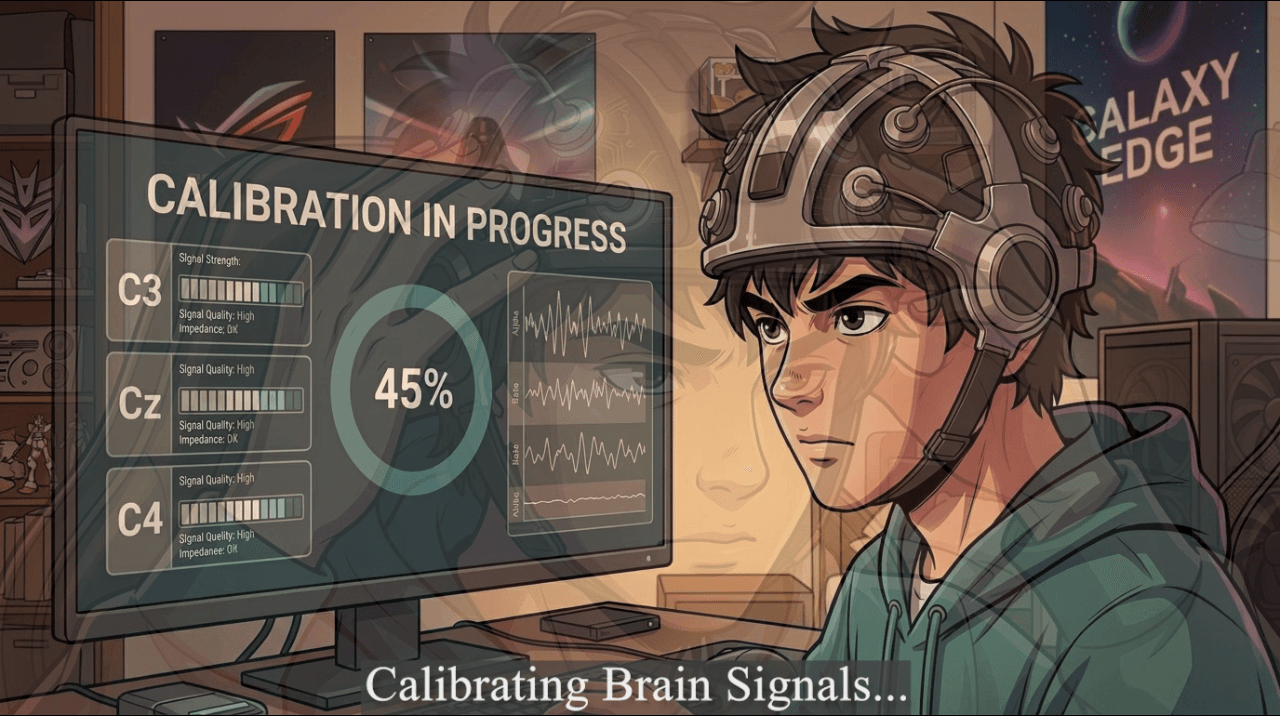
User-supplied animation explaining headset setup, calibration, and hands-free gaming. This is an illustrated concept walkthrough, not a recording of the running prototype or a validation of its accuracy.
Repository-reported accuracy and balanced accuracy for raw channels 0,3,4 cropped to 3 seconds. The report evaluates a saved model on a matching dataset; it does not establish a held-out split or across-user generalization.
Hand motor imagery versus rest.
Three branches with shared command arbitration and cooldown.
README reports passing checks for signal processing, channel selection, cooldown, blink buffering, and gyroscope processing. These are software checks, not proof of end-to-end usability.
Capabilities and result snapshots follow the project's current README, reviewed October 11, 2026. Read the source
Document a leakage-free, held-out evaluation across sessions and users, then measure false activations and end-to-end command latency during real gameplay. Clarify my individual responsibilities within the team.
Open my Software & AI CVWorkflows that survive the unhappy path.